

Every container of hazardous chemicals you ship needs a GHS label with the right pictograms, signal word, hazard statements, and precautionary statements. The label has to be accurate and legible, and it has to stay that way through handling, storage, and transit.
Most chemical manufacturers still solve this with pre-printed labels or thermal transfer printing, and if that's your situation, the frustrations will be familiar. With pre-printed labels, you're stocking a roll for every product, container size, and language, then scrapping the leftovers when a formulation changes or a regulation is updated. You're also placing minimum orders and waiting on lead times just to get a label you needed yesterday.
With thermal transfer, you're often still buying pre-printed color pictogram stock to run alongside your black-and-white text, so you're managing two supplies (labels and ribbons) and hoping the right roll is loaded for the right product. On the production floor, this shows up as line stoppages for roll changes, the constant risk of a wrong-label mix-up, labels that smear or fade after being splashed or shipped, and a shelf of stock that's obsolete the moment something changes.
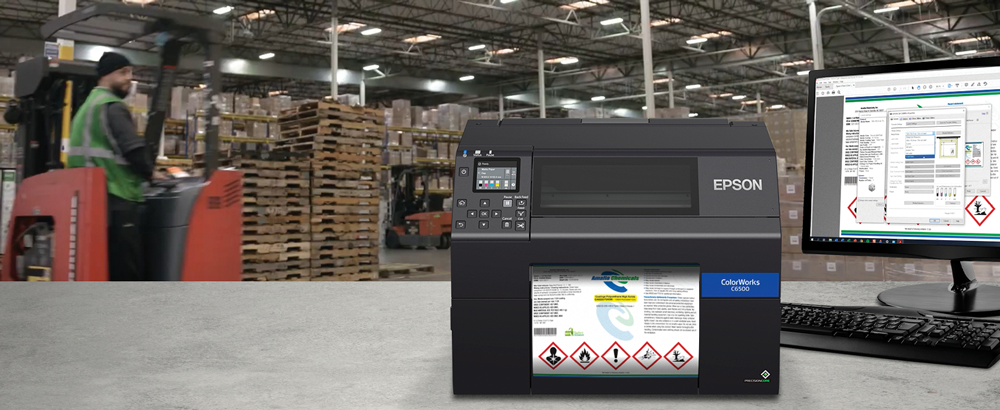
Epson ColorWorks color inkjet label printers offer a better way. They print the entire GHS label, including full-color pictograms, on demand on blank stock, so you print what you need, when you need it. Here's why they fit GHS labeling so well.

GHS pictograms are red-bordered diamonds, and many operations handle them with pre-printed color rolls, or with color pre-printed stock plus a thermal transfer printer for the variable text. That means at least two processes and a lot of roll management.
Epson ColorWorks prints the entire label on blank stock in one pass. That means the product name, hazard text, barcodes, pictograms, and your branding all come out in full color at once. There's no pre-printed inventory to buy, store, or reconcile, and no second step where a mistake can creep in.
Durable, Chemical-Resistant Pigment Ink
Chemical containers get splashed, scuffed, stored in damp warehouses, and shipped long distances. A label that smears or fades defeats its purpose.
Epson ColorWorks inkjet label printers use water- and chemical-resistant Epson UltraChrome DL pigment inks to print GHS labels that resists smudging, smearing, and fading. Pigment ink sits on the label surface and resists moisture and abrasion far better than typical dye-based inks.
BS 5609 Certification With The Right Media
Epson ColorWorks printers, when used with UltraChrome DL inks and select General Data inkjet label media, produce GHS labels that are BS 5609 certified.
BS 5609 is the British standard for adhesive labels used on chemicals shipped by sea, and it's referenced in the IMDG Code. It tests that printing stays legible and the label stays adhered, including after prolonged seawater immersion.
Certification applies to the printer, ink, and media together, so the label stock matters as much as the printer. That's where General Data comes in: we manufacture BS 5609-certified inkjet labels designed for the ColorWorks platform, so the combination you buy is the combination that was tested and certified.
Compact, Plug-In Simplicity For The Production Floor
ColorWorks printers are on-demand, industrial-class inkjet label printers, built to sit at the filling station, packaging line, or shipping dock rather than in a print room. Printing at the point of use puts label creation in the hands of the people who are producing, packaging and shipping the product.
Is Epson ColorWorks The Right GHS Label Printing Solution For You?
It's worth a closer look if you:
- Handle many SKUs, container sizes, or label variants
- Scrap pre-printed labels when formulations or regulations change
- Need to have BS5609 certified GHS labels
- Need labels that survive chemical exposure, moisture, and handling
- Want to bring label printing in-house and print at the point of use
Pre-printed Labels | Thermal Transfer (monochrome) | Epson ColorWorks + General Data BS5609 Inkjet Labels | |
How it works | Labels printed in bulk by a converter, sometimes with variable text added later | Ribbon heat-transfers black text to label stock; pictograms usually come from pre-printed color stock | Full label, including color pictograms, printed on blank stock in one pass |
Color pictograms | Yes, printed in advance | Only if you buy pre-printed color stock | Yes, printed on demand |
Process steps | Order, store, load the correct roll | Buy pre-printed stock plus ribbon, then print variable text | Load blank stock and print |
Inventory | One roll per product, size, or variant | Pre-printed stock per pictogram set, plus ribbons | One blank label type per size |
Formulation or regulatory change | Old rolls are scrapped, new run required | Pre-printed stock may be scrapped, text updates required | Update the file and print; nothing to scrap |
Short runs and many SKUs | Poor fit: minimum order quantities and lead times | Good for text, but pictogram stock still has to match | Well suited: any label design, any quantity, on demand |
Durability | Depends on the converter's materials and inks | Durable when a resin ribbon is used | Water- and chemical-resistant pigment inks; BS 5609-certified with select General Data media |
Lead time for a new label | Days to weeks | Immediate for text, but pictogram stock must be on hand | Immediate |
Risk of wrong-label errors | Higher: many similar rolls to pick from | Moderate | Lowest: the label is generated from the product record |

General Data is a label manufacturer, a certified reseller of Epson ColorWorks printers, and an expert at industrial printing systems that work with ERP and manufacturing systems - so you get the entire solution from one source:
- Printer selection matched to your volume, label sizes, and workflow
- BS 5609-certified inkjet labels from a company that manufactures labels
- Label printing software and systems that integrate with your ERP, MES and other production systems
- Certified service and support from a team that also repairs and maintains label printers