
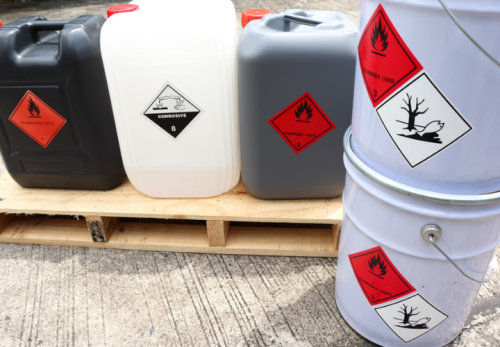
Since the introduction of the Globally Harmonized System of Classification and Labeling of Chemicals (GHS), color has played a critical role in how hazard information is communicated. From standardized pictograms to visual clarity on chemical containers, color is not a design choice—it is a functional requirement of compliant GHS labeling.
As labeling requirements continue to evolve and operations become more efficiency-driven, organizations are reassessing whether their current GHS label printing systems are still the right fit.
The Role of Color in GHS Labeling
GHS labels rely on visual elements to quickly and clearly communicate hazards. Pictograms enclosed in red diamond borders are a defining feature of the system, helping workers identify risks at a glance. Consistent color use improves readability, reduces interpretation errors, and supports safer handling of hazardous materials.
For companies producing chemical labels in-house, this creates a challenge: how to reliably produce compliant, color-based GHS labels without adding unnecessary complexity or cost.
Designed for GHS Applications: The Cab XC Q Series
The Cab XC Q Series Industrial Two-Color Thermal Transfer Label Printers are purpose-built for applications like GHS labeling. With two independent print heads, the XC Q series prints dual-color labels in a single process, delivering the clarity required for hazard communication.
Additional features—such as automated ribbon-saving technology, high-resolution output, and industrial durability—support continuous production environments while helping control operating costs.
Just as important, the XC Q series allows organizations to move away from rigid, pre-printed labeling systems and toward a more adaptable, efficient approach to GHS compliance.
Planning for the Next Step in GHS Labeling
As more companies revisit their GHS labeling systems, the focus is shifting from simply meeting requirements to building workflows that are reliable, efficient, and easier to manage over time. Two-color printing plays a key role in that transition.
Choosing the right printer—and the right partner—can make all the difference.
Ready to Learn More?
General Data works with organizations across industries to design GHS labeling systems that are compliant, practical and scalable. From the cab XC Q Series printers to compatible label materials and system support, we help simplify GHS labeling from start to finish.
Learn more about upgrading to a two-color GHS labeling solution.