
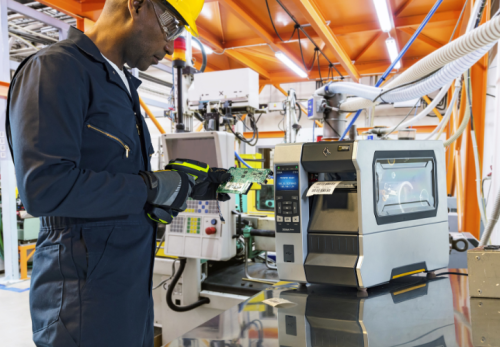
For manufacturing operations, uptime isn’t optional—it’s operational survival.
Printers, scanners, mobile computers, rugged tablets, and IoT devices all play a direct role in production, warehousing, shipping, and traceability. When they fail, production slows. When they’re unavailable, workflows stop. That’s why having a reliable service provider isn’t just helpful—it’s strategic.
General Data’s Service Division has long focused on keeping devices operational through preventive maintenance, responsive repair, and nationwide support programs. Our customers depend on us to reduce downtime, extend equipment life, and keep teams productive.
But today, uptime depends on more than equipment reliability. It depends on secure, controlled, and accountable access.
Introducing Frontline Identity, Access & Management (FIAM)
General Data now offers Frontline Identity, Access, and Management (FIAM) from 42Gears as an option within our service agreements for manufacturing operations.
FIAM goes beyond device management by unifying three critical pillars into one platform:
1. Device Trust
Ensures devices are compliant, patched, secure, and healthy before access is granted. Kiosk controls, threat defense, and device posture monitoring establish whether a device can be trusted.
2. User Identity
Enables fast, passwordless authentication designed for industrial environments—such as NFC badge tap or QR-based login—allowing seamless user switching on shared devices without credential sharing.
3. Least-Privilege Access
Grants access only to authorized applications through per-app tunneling—eliminating full network exposure and enforcing true Zero Trust principles.
Instead of granting broad VPN access, frontline users receive access only to the applications they need, nothing more.
Why This Matters for Uptime
In modern manufacturing environments, security incidents and access failures are just as disruptive as hardware breakdowns.
FIAM transforms managed devices into truly secure devices.
By integrating identity, access control, and device management into a unified platform, organizations can:
- Reduce credential sharing and compliance risk
- Prevent unauthorized network exposure
- Simplify shift-based authentication
- Improve accountability and audit readiness
- Support a Zero Trust security model
- Protect productivity at the point of work
When devices are secure, authenticated properly, and restricted to the right applications, frontline teams experience fewer disruptions and IT teams gain centralized visibility and control.
This is not a standalone software offering. FIAM is now available as part of General Data's Service portfolio, giving manufacturing operations a single partner for:
- Equipment service and preventive maintenance
- Device management
- Identity and access enforcement
- Secure application-level connectivity
It's the next evolution of uptime.
Because keeping devices running is no longer enough. They must also be secure, controlled and accountable.
Manufacturing uptime depends on more than keeping devices running. It requires secure, controlled access at every point of work. With FIAM integrated into General Data's service portfolio, organizations can protect productivity while strengthening security across the frontline.
Contact General Data to learn how FIAM can fit into your service agreement and support your frontline operations.